October 13, 2026
·
10 min read
9 Limitations of Testimonial Release Forms in 2026
What a testimonial release form really covers in 2026, the 9 gaps it won’t fix, and a go/no-go checklist for publishing customer quotes.

You want to publish a customer quote on your website and move on. The obvious move is to grab a standard testimonial release form, file it away, and assume you’re covered.
But the risk usually shows up somewhere else: the claim the quote implies, what you promised in exchange, whether you can prove consent later, whether you can take it down fast, and whether a third‑party review can be republished at all. This collection scopes what releases really do, lists nine limitations you still have to manage, and gives a set of controls and a go/no-go checklist for publishing in 2026.
Release forms, scoped
What it grants
A testimonial release form can give you permission to use customer testimonials in the narrow sense: a copyright license (permission to reuse their words, photo, or video) and, where relevant, consent under the right of publicity (their ability under state law to control commercial use of their name/likeness/voice). That’s real value—but it’s not a compliance force field.
Even with a signed release, the FTC still expects a testimonial (an ad message people will take as a real customer’s experience) to reflect the endorser’s honest opinions and not communicate anything that would be deceptive if you said it yourself. You also still need substantiation—including competent and reliable scientific evidence where appropriate—because “the customer said it” is not the proof. And if a testimonial implies results are typical, you need to back that up or clearly and conspicuously disclose generally expected performance; the FTC’s own examples treat “Results not typical” as insufficient when the net impression implies big outcomes are common (see FTC guidance on typical results). If there’s a material connection (payment, free product, prize chance), that disclosure duty survives the release.
Definitions that matter
A consumer review is different: it’s a consumer’s evaluation submitted to and published on a site or platform dedicated (in whole or part) to displaying reviews. When you copy that review onto your own site, the FTC treats you as “disseminating” it under 16 CFR Part 465, which took effect on October 21, 2024—so a release doesn’t help if the review is fake or false.
Finally, don’t turn a “release” into review suppression (pressuring negatives to disappear): the Consumer Review Fairness Act makes it illegal to use form-contract terms that restrict honest reviews or penalize reviewers. A release is permission from a person—not a waiver of FTC rules, platform terms, or basic truth-in-advertising limits.
Nine limitations of testimonial release forms in 2026
A signed release answers one narrow question (“Can we use this person’s words/likeness?”). The risks that still bite are operational: what the testimonial implies, how you sourced it, and what you can prove later.
-
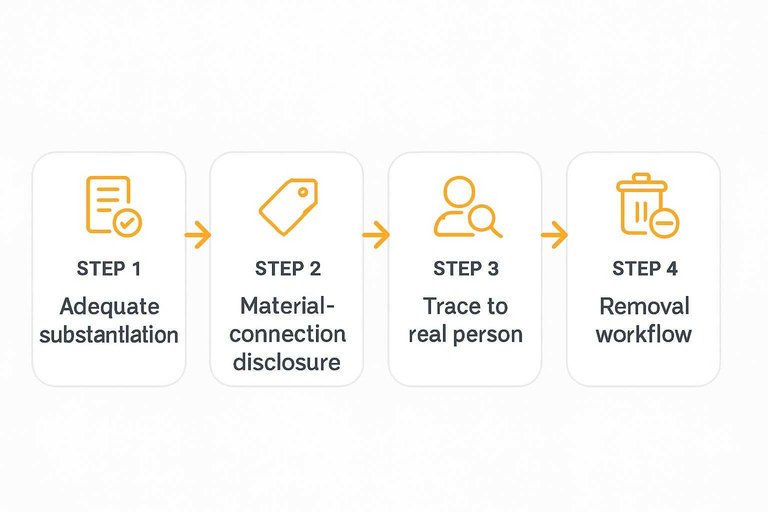
FTC substantiation and implied-claim risk (including “typical results”). A release doesn’t give you proof for the claims a testimonial communicates; the FTC Endorsement Guides still expect “adequate substantiation,” and the customer’s statement itself isn’t “competent and reliable scientific evidence.” Example test: highlight every factual claim in the quote (time saved, dollars earned, health outcome) and ask, “What file would we hand over to substantiate each one?”
-
Material-connection disclosure still applies. If there was payment, free/discounted product, or even a prize chance, disclosure is still required when it could affect credibility and isn’t expected by the audience. A release can’t replace that disclosure. Example test: for each testimonial source (direct request, influencer, review capture), answer “Did they get anything of value?” If yes, confirm the disclosure is attached to the endorsement itself, not buried elsewhere.
-
You can still trip the FTC’s consumer-review rule (Part 465) even with permission. Republished reviews are regulated as “consumer reviews,” and the rule banning fake review/testimonials is enforceable on its effective date (60 days after Federal Register publication). A signed document doesn’t cure “not real,” “not from an actual user,” or “we can’t show where it came from.” Example test: pick one quote at random and trace it back to a real person and a real interaction (order, invoice, support ticket, account). If you can’t, treat it as unpublishable.
-
Anti-gag / review-suppression rules can make your “release” the problem. If your template slips into non-disparagement, penalties for negative feedback, forced removal, or “we approve reviews before you post,” you’re no longer just getting permission—you’re restricting reviews. Example test: search your release for “non-disparagement,” “remove,” “take down,” “penalty,” “fee,” “refund only if,” or “must be approved.” If any appear, rewrite before you collect another signature.
-
Revocation and deletion requests don’t stop at your signature box. Under GDPR, a person can withdraw consent at any time; under the CCPA, consumers have a right to request deletion of personal information (with exceptions) and businesses must verify the requester’s identity. A release doesn’t eliminate the need for a removal workflow. Example test: list every place the testimonial propagates (site pages, landing pages, paid ads, email sequences, sales decks). If you can’t name them, you can’t reliably remove them.
-
Authority/capacity gaps: the signer may not be able to grant what you think. The person might be a contractor without rights to speak for the company, or a minor; California’s right-of-publicity statute expressly requires a parent/guardian’s prior consent for minors. Example test: for any face/voice testimonial, record who is being depicted and who signed. If those aren’t the same person (or the person is under 18), pause and re-paper it.
-
IP ownership isn’t guaranteed by “I agree.” The customer can license you their words and likeness, but they may have included third-party photos, music, screenshots, or a coworker’s image in the asset you’re reusing. Their signature doesn’t magically transfer other people’s rights. Example test: for any video/photo, ask “What else is in frame or in the audio?” (logos, background music, stock images, other people). If the answer is “we don’t know,” don’t publish the raw asset.
-
Platform/API terms can block reuse even when the reviewer says yes. A reviewer can grant personal permission, but they can’t waive the platform’s contract restrictions for how you access and store review content. For example, the Google Maps Platform Terms include a no-scraping restriction and explicitly prohibit copying and saving user reviews. Example test: diagram your pipeline. If it includes “copy review text from a platform/API → save in your database → render on your site,” treat it as a ToS risk until you switch to an authorized method.
-
Evidentiary problems: later, you may not be able to prove assent. In a dispute, “we had a release” is only as strong as your records: who agreed, to what exact language, on what date, tied to what testimonial version. Example test: pull the signed record and verify it includes the full terms shown at signing, the signer’s identity, and the exact testimonial/media covered—without relying on someone’s inbox archaeology.
Controls that survive pushback
When permission to use customer testimonials gets challenged, the form is rarely the weak point—your workflow is. If you can’t run the control, treat that testimonial format/claim as “don’t publish.”
| Limitation (what the release doesn’t solve) | Minimum operational control | Minimum record you must keep | Tooling option (optional) |
|---|---|---|---|
| Substantiation + implied “typical results” | Claim inventory + substantiation file; typical-results review (no “Results not typical” patch) | Evidence pack linked to the exact quote/version | None |
| Material-connection disclosure | Incentive/disclosure fields at collection; disclosure carried with every reuse | What they received + exact disclosure text + where it appeared | None |
| Part 465 exposure when republishing reviews | Identity + transaction verification before publish (16 CFR Part 465) | Order/invoice/ticket ID + source-of-text chain | None |
| CRFA / review-suppression risk | Separate “permission” from “review rules”; template review for gag terms (use testimonial request email templates that avoid pressure language) | Current approved template version + change log | None |
| Revocation / deletion / takedown | Removal workflow + propagation map (site, ads, email, decks) + owner | Takedown ticket + where removed + timestamps; §3344: cease distribution within two business days if ordered | None |
| Authority/capacity gaps | Signer role check; guardian consent for minors; company approval when needed | “Who is depicted” + “who signed” + relationship/role | None |
| Third-party IP inside assets | Asset clearance checklist before publish; edit out what you can’t clear | Rights notes (music, screenshots, other people) + final approved file | None |
| Platform/API terms block reuse | Source tracking + allowed ingestion method (embed/link vs copy/store) | Platform + method + ToS snapshot/date (e.g., Google ToS effective date tracking) | None |
| Can’t prove assent later | Versioned consent capture + approval audit trail; signature-grade capture where required (E-SIGN) | Signer identity + timestamp + terms shown + testimonial/media version | ShowTrust: first-party consent fields + approval audit trail |
Choose proof level
Treat “proof” as a channel-by-channel decision: for short written quotes, some teams default to a signed release, but some practitioner guidance treats a clear “yes” by email as usually enough—while photo/video/voice use is where signature-grade proof is worth the friction.
Email vs signature
For a short, text-only testimonial, many teams can defend lightweight assent; as soon as you’re using a person’s likeness (or buying distribution), upgrade the proof.
- Lightweight is fine: a short, text-only quote where you’re not using the person’s face/voice and you can keep the exact wording you asked to publish.
- Move to signature-grade: anything using likeness (photo/video/voice), anything you’ll run in paid ads, or anything where a takedown would force a costly re-edit.
- If you rely on electronic consent, build it like evidence. Under E‑SIGN (the U.S. law that gives electronic signatures legal effect), you want a record that ties who agreed to what exact language on what date/time, and that you can reproduce later.
- If you can’t version it, don’t “wing it.” Signature-grade consent is often less about legality and more about preventing “we can’t prove what they agreed to.”
Don’t rehost reviews
Reviewer permission isn’t the only permission that matters—platform terms can still block copying and storage.
- If the review lives on Yelp, don’t scrape or copy it into your database; Yelp says scraping/copying violates its Terms, and points you to share/embed options it expressly authorizes.
- If your pipeline involves the Google Maps Platform, treat “copy/save reviews” as a ToS risk and track ToS updates (Google’s general ToS page shows an effective date of July 30, 2026).
- Prefer links, embeds, and clear attribution over “rehosting” text.
- When you need full control, re-collect first-party: ask the customer to submit a fresh testimonial directly to you (even if it’s the same sentiment).
Go/no-go checklist (publish gate)
Run this before you publish any testimonial (or republish a review).
- Permission scope: Confirm you have permission for this exact quote/media, person/likeness, and channel (site, ads, email), and store the versioned record of what they agreed to.
- Claims file: Mark every express/implied claim the endorsement communicates and attach substantiation; don’t “patch” extreme outcomes with “Results not typical” if the net impression implies they’re representative (FTC, 16 CFR Part 255).
- Disclosures: If there’s any material connection, put the disclosure on the endorsement itself, clearly and conspicuously.
- Source/ToS rights: If it’s a consumer review you’re republishing, verify it’s real and traceable (16 CFR Part 465) and that your method complies with platform terms (e.g., Google Maps Platform Terms of Service, Yelp Terms of Service).
- Removal workflow: Maintain a propagation map and an owner; honor withdrawal/deletion requests (GDPR/CCPA) and be able to cease distribution within two business days if ordered under California Civil Code § 3344.
Treat the form as permission—then prove it
A testimonial release answers “can we use this person’s words/likeness?”—it doesn’t make the endorsement substantiated, properly disclosed, removable on request, or safe to republish from a platform. The practical line in 2026 is simple: if you can’t attach a claims file, carry material-connection disclosures with the quote, trace the source, and execute a fast takedown across every place it appears, you shouldn’t publish that testimonial in that format. Start by running the go/no-go checklist on one testimonial already live; whatever you can’t document or unwind is the same thing you shouldn’t put back on the page tomorrow.
Frequently Asked Questions
- If I have permission to use customer testimonials, do I still need to comply with FTC rules?
- Yes—permission only covers using the person’s words/likeness; it doesn’t waive FTC requirements. If you’re running endorsements you’re under the FTC Endorsement Guides (16 CFR Part 255), and if you republish consumer reviews you can also trigger the FTC consumer-review rule (16 CFR Part 465).
- Is republishing a customer review on my website the same as running a testimonial?
- Not quite: a review copied from a review platform and republished as marketing is treated as a “consumer review” you’re disseminating, which can bring 16 CFR Part 465 into play. A first-party quote you collected for marketing is typically handled under the FTC Endorsement Guides framework.
- Can I use “Results not typical” to safely publish extreme outcome testimonials?
- No—the FTC’s Endorsement Guides give an example where “Results not typical” is insufficient if the ad’s net impression implies those results are representative. Either substantiate that the results are typical or disclose generally expected performance in a way that changes the net impression.
- Is an email ‘yes’ enough permission to use a customer testimonial, or do I need a signed release form?
- For U.S. electronic consent, the legal effect of an e-signature is covered by E-SIGN, so what matters is having a record tying who agreed to the exact terms and what content they approved. If you can’t reproduce the terms shown at acceptance and connect them to the exact testimonial version, upgrade your consent capture.
- How fast do I need to be able to remove a testimonial if someone revokes permission or demands a takedown?
- Treat removal as an operational requirement across every place you published it (site, ads, email, decks) and keep a propagation map so you can execute quickly. For California right-of-publicity court orders under Civil Code § 3344, you may need to cease distribution within two business days unless the order requires otherwise.
Publish Testimonials You Can Stand Behind
Once you’ve run the checklist, the next bottleneck is execution: collecting clean approvals, keeping submissions organized, and only showcasing what you’ve actually vetted.
ShowTrust gives you a hosted collection page and an embeddable wall of love where testimonials flow into Pending for review, and only approved (and pinned) quotes show up on your site.
Written by
ShowTrust
Notes from the ShowTrust team on collecting testimonials and building authentic social proof.
Share: