September 12, 2026
·
8 min read
How Testimonials on Pricing Pages Work: Advanced Trust Cues
Use testimonials for pricing page as verifiable proof: map objections to reviews, show the right metadata, follow FTC/Google constraints, and avoid trust-breaking UX.

You’re rewriting a pricing page and you need proof that makes a buyer feel safe committing money, not a block of flattering quotes. When testimonials look curated, anonymous, or too perfect, visitors start second-guessing the offer, cross-checking elsewhere, and hesitating right where your conversion should peak.
This explainer shows how pricing-page testimonials work as advanced trust cues: how to map objections to proof, govern the “proof chain” behind each quote, decide what verification metadata to display, account for 2026 constraints, and avoid UI patterns that quietly undermine credibility.
Pricing-Page Reality
On a pricing page, testimonials for pricing page aren’t brand decoration—they’re decision-stage evidence. They work when they answer purchase hesitation at the moment someone is about to commit money, time, and reputation—not when they sound inspirational. That means aiming them at “moment of decision” objections like ROI, switching effort, and whether you’ve worked with similar-sized companies.
Objection-to-proof map
| Objection (price/risk/fit) | Testimonial claim type | Fastest verifiability cue | Common skepticism trigger |
|---|---|---|---|
| “It’s expensive” | ROI or cost offset | Specific before/after context | “Sounds like ad copy” |
| “Switching will hurt” | Migration effort + timeline | Mentions tools/process used | No date or details |
| “Not for my use case” | Fit for segment | Clear segment match | Vague “works for everyone” |
| “Will it actually work?” | Outcome + limits | Links to external proof | Only perfect quotes |
Buyers also cross-check. Nielsen Norman Group notes people can be leery of on-site quotes because they assume you curated only favorable ones—and they compare what you show against third-party review sites anyway. An isolated page with no credible external references can look like it has something to hide.
Aggregate rating / star average—meaning a summarized rating number like 4.6/5—often outweighs any single quote. Spiegel’s guidance puts the purchase-likelihood “sweet spot” in a 4.0–4.7 range, and explicitly recommends embracing negative reviews because they establish authenticity.
Trust-signaling language
- Reviews: implies a broader set, not just highlights.
- Endorsements: implies a person is staking reputation.
- Customer stories: implies narrative and context, not a one-liner.
- Feedback: implies you collect criticism too.
- Case studies: implies attributable, checkable detail.
The line you’re walking is simple: pricing-page “trust” isn’t vibes—it’s how quickly a claim can be checked, and whether your curation is honest under rules that forbid fake reviews and deceptive suppression.
Proof Chain Governance
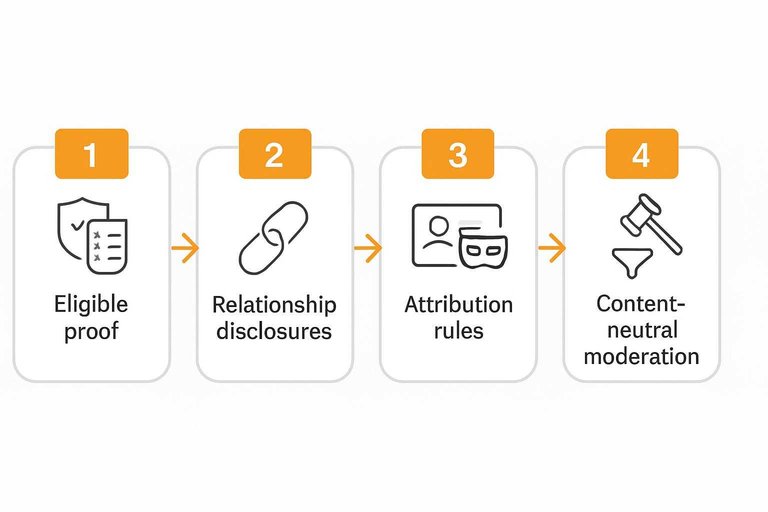
A pricing-page quote is only as credible as its proof chain: how you sourced it, what you disclose about the person behind it, how you moderate it, and what your display implies about what’s missing.
-
Define “eligible proof” before you collect. Decide who can submit (customer, partner, employee), what counts as a real experience, and ban anything that would misrepresent that the reviewer exists, used the product, or accurately describes their experience—because 16 CFR Part 465 prohibits businesses from purchasing or disseminating that kind of misrepresentation.
-
Disclose relationships where they change how buyers weigh it. A material connection (payment, employment, gifts, etc. that could affect an endorsement) must be paired with a clear and conspicuous disclosure (shown so people will actually notice and understand it, not buried) when officers, managers, employees, or agents are providing testimonials and the relationship isn’t otherwise obvious.
-
Choose attribution rules explicitly. Attribution (public vs anonymized) is whether the reviewer’s identity is shown publicly or kept anonymous while still being verified internally; some review platforms allow anonymity without changing acceptance, while still moderating against conflicts.
-
Write moderation rules that are content-neutral. ISO 20488:2018 frames moderation as a defined process; the FTC rule gives examples of neutral reasons to withhold reviews (defamatory/abusive content, personal info, clearly false/misleading, unrelated, or reasonably believed fake).
-
Be honest about curation—and avoid implying completeness. Review suppression is hiding or making reviews non-displayable based on rating/negative sentiment while implying the set shown represents most or all reviews; that implication is the compliance and trust failure line.
If you can’t point to your sourcing, disclosures, and moderation rules in one pass, your testimonial block reads like selective marketing—even when every quote is real.
Verification Metadata
Treat each pricing-page testimonial as a record a buyer can interrogate, not a pretty quote. A Verified buyer / verified current user badge—a label indicating the reviewer’s identity/usage was verified by a platform or process—only works as a trust cue when it’s paired with the fields that make the claim traceable (who said it, when, in what context, and where the original lives) and supported by third-party validation.
| Metadata field (show it) | Skepticism it prevents | Verification label examples | What a “good” example looks like |
|---|---|---|---|
| Name, role, company | “Could be invented” | Public attribution, or anonymized | “[Name] — [Role], [Company]” |
| Segment + use case tag | “Not like me” | “SMB / Mid-market / Enterprise” | “B2B SaaS, 20–50 seats” |
| Date (and version/plan) | “Too timeless to trust” | “Reviewed on YYYY‑MM‑DD” | “Reviewed after upgrade to Pro” |
| Verification badge | “Did they really use it?” | Verified current user / buyer | “Verified current user” |
| Source link + balancing signal | “Cherry-picked perfection” | Link to original review | “One drawback + why it stayed worth it” |
If you can’t verify identity publicly, you can still publish anonymized but verified testimonials. For example, on G2 reviewers can choose review attribution on (public) or off (anonymized), and that choice does not affect whether a review is accepted or rejected—while moderation can still see the reviewer’s information either way (see review attribution (public vs anonymized)).
A strong, verifiable pricing-page example reads like: “[Role], [Company] (Mid-market, 50 seats) — Verified current user — Reviewed 2026‑03‑14 — Source: [link]. ‘Implementation took longer because [constraint], but we stayed because [decision-stage outcome].’
Constraints in 2026
Some “verification” tricks are simply off the table now, because platforms and regulators define what counts as credible proof.
Start with Google. Self-serving reviews—reviews about your own business published on your own site (even through embedded third-party widgets)—don’t earn the same treatment as independent review sources. Google has said these self-serving reviews will no longer generate review rich results for LocalBusiness and Organization schema types when the reviewed entity controls the reviews (see Google’s review rich results update). So adding schema.org Review / AggregateRating markup to your pricing page isn’t an SEO shortcut to star snippets when you’re the publisher.
Then there’s the FTC. The Consumer Reviews and Testimonials Rule (16 CFR Part 465) took effect October 21, 2024, and the prohibitions are aimed at business conduct; ordinary consumers aren’t the target of liability under the rule. The practical constraint for a pricing page is simple: your collection and curation workflow has to be designed so you’re not buying, manufacturing, or selectively hiding reality.
Finally, incentives are a two-layer problem: what the FTC allows vs. what platforms allow. FTC guidance says incentives aren’t categorically banned if you’re not requiring positive sentiment, but paying incentives specifically for 5‑star reviews on third-party platforms violates Section 465.4. Separately, platform policies can be stricter—Trustpilot says you shouldn’t provide incentives (discounts, gifts, points, coupons, referral bonuses) when asking for reviews.

UX Integrity Patterns
On a pricing page, your testimonial UI is part of the evidence. If the interaction feels slippery—auto-advancing quotes, motion you can’t stop, or a widget that janks the page—you lose the trust you were trying to borrow.
Start by treating motion as an accessibility contract. WCAG Success Criterion 2.2.2 (Pause, Stop, Hide)—an accessibility requirement that auto-moving content lasting more than 5 seconds must be pausable/stoppable/hideable under common conditions—kicks in fast on marquees and carousels. If you insist on motion, ship explicit Pause/Play controls, make them keyboard-focusable, and honor reduced-motion preferences; otherwise, use a static grid/list and let the reader scroll.
Then protect performance on the one page that matters most. Prefer rendering that doesn’t block your pricing table or CTA: reserve space so the testimonial block can’t cause layout shift, keep embeds below the fold if they’re non-essential, and avoid third-party scripts that compete with your checkout analytics. A widget that lazy-loads and renders cached HTML is the right shape here because it reduces main-thread work while still showing real content quickly.
Linking out is a trust pattern, not a navigation failure—when it’s earned. If a testimonial implies “verified,” show a clear “Source” link next to it so the claim is checkable, and open it in a new tab so the pricing decision stays anchored; it’s one of the simplest trust signal best practices you can implement.
ShowTrust on pricing
- Collect reviews via the hosted collection link.
- Approve submissions in the dashboard, and pin the few you want anchored on pricing.
- Embed the widget snippet (script + container) on the pricing page.
- Pick a layout and filtering that matches how buyers self-identify (segment/use case).
- Style it to match your UI (including a CSS escape hatch) and avoid marquee mode unless you’re implementing WCAG 2.2.2 controls; note the widget script is claimed to be under 5kb gzipped and to lazy-load while rendering server-cached HTML, and video is not shipped yet.
Make testimonials checkable evidence
On a pricing page, a testimonial only earns trust when it behaves like evidence: it answers a specific decision-stage objection and gives the buyer fast ways to verify who said it, when, in what context, and where the original lives. If your block can’t survive a quick cross-check—or it looks like you filtered reality—people treat it as self-serving marketing and hesitate right at the commit point. Your first move is to pick the objection you’re trying to neutralize on pricing, then attach one review whose proof chain (sourcing, disclosures, moderation, and non-suppression) you can defend in a single pass, with the metadata and source link visible beside it. If you want that workflow to stay lightweight in the UI, use a collection + approval flow and a performance-safe embed (e.g., ShowTrust); if you already have a credible third-party review presence, prioritize linking and mirroring verifiable records over designing prettier quotes.
Frequently Asked Questions
- Should testimonials for a pricing page link out to third-party review sites like G2 or Trustpilot?
- Yes—add a clear “Source” link to an external, unbiased page when you can, because an isolated site with no outside references can look like it has something to hide. Include a mix of sentiment (not just perfect quotes), since negative reviews increase credibility and authenticity.
- Is it bad to show negative reviews in testimonials for a pricing page?
- No—include some negatives (or balanced quotes that mention a drawback) because negative reviews build credibility and authenticity. Use them to set expectations and reduce “too-good-to-be-true” skepticism.
- Can I use a testimonial carousel or marquee on my pricing page without hurting accessibility?
- Only if auto-moving testimonials that run longer than 5 seconds have a clear Pause/Stop/Hide control that works with keyboard focus. If you can’t meet that requirement, use a static list or grid instead.
- What process should I follow to moderate pricing-page testimonials without looking like I’m suppressing reviews?
- Use an explicit, documented moderation workflow with content-neutral rules, aligned to ISO 20488:2018’s guidance for collecting, moderating, and publishing online reviews. Publish (or link) your moderation criteria so readers understand what gets removed and why.
- How do I embed verified-looking testimonials for my pricing page without building a custom system?
- Use a tool that provides a hosted collection page and an embeddable widget so you can display approved testimonials consistently across pages. With ShowTrust, you embed a single script plus a container div, and its API uses the https://api.showtrust.to/v1 base URL with x-showtrust-account-id and x-api-key headers for authenticated endpoints.
Ship checkable proof on pricing
Knowing what makes a testimonial credible is one thing; implementing sourcing, approvals, and fast verification cues without slowing your page down is the hard part.
ShowTrust gives you a hosted collection page plus an embeddable wall of love widget, so you can approve, pin, and publish testimonials prospects can sanity-check at the commit point.
Written by
ShowTrust
Notes from the ShowTrust team on collecting testimonials and building authentic social proof.
Share: